Stage 27
Lucky Day
Another gorgeous morning. As dawn breaks, the rising sun burns off the morning fog. The bright blue sky stands ready to reveal itself. The temperature is comfortable. I decided on shorts.
I started late, choosing to linger in my hotel room to finish a blog article and enjoy the view from my room. It wasn’t until after 10 that I hit the trail, which was quiet, despite my position well into the stretch past Sarria.
Shortly after starting, the path presented me with options. This was not normal. Usually, decisions aren’t required. The standard is to just follow the yellow arrows. Today there were two, facing opposite directions.
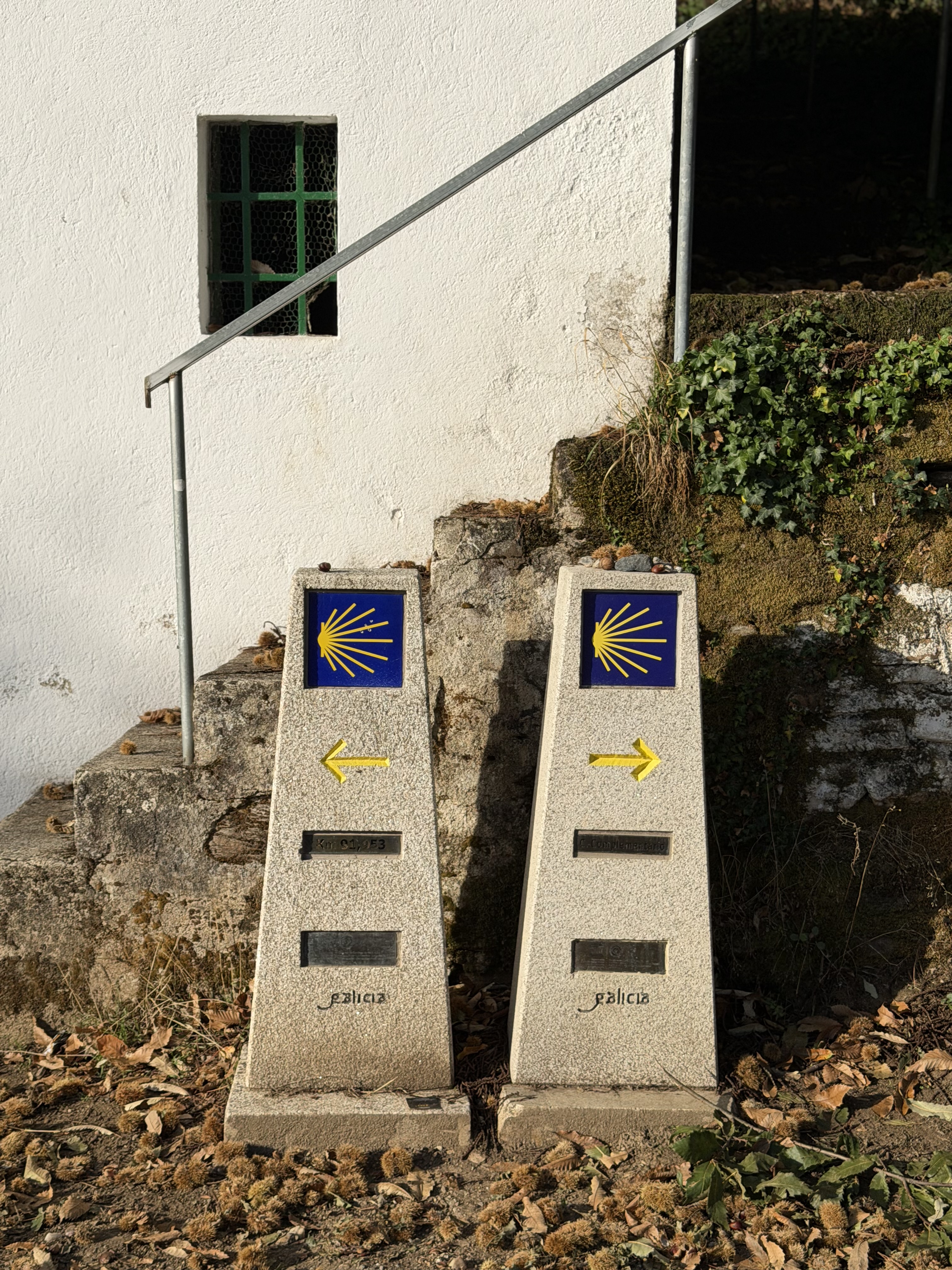
The left arrow pointed to a sidewalk while the path to the right led to a forest. I went for the wooded path. Other than a middle-aged couple and a solo pilgrim, the trail was empty at my late morning start. This was not surprising, even after Sarria, as most pilgrims start their days around 7 a.m. Given my fast walk, I passed the stragglers and had the road to myself.
I hiked for around an hour, just past 11, when I encountered a cafe. I was already hungry and unsure when I might find my next option, so I decided to stop, approaching lunchtime with fewer miles behind me than usual. Although the establishment seemed more commercial than a typical Camino cafe, advertising a large picture menu on an outdoor, ground level billboard, the lunch options enticed me, especially the photo of the soup. I entered, my mouth already watering. Upon ordering, I was disappointed to learn McDonalds rules did not apply. No soup for me. Only breakfast options were available until noon, so I went for eggs and sausage served with bread, all over fries, along with coffee with milk and a can of Aquarius. For some reason, the breakfast menu also offered appetizers, so I also requested a plate of cheese, anchovies, and olives served with toast – probably an over-reaction to my soup denial.
I took a table outside where a group of women kept catching my eye and smiling as I awaited my meal. I appreciated the friendly gestures and eventually struck up a conversation. My ability to converse with them in Spanish surprised and delighted them, and we proceeded to talk for a good ten minutes or so until my food arrived.
They were pilgrims from Colombia who had started in Sarria. They were deeply impressed, even in awe, when they learned I had begun my journey in Saint-Jean-Pied-de-Port.
They asked if I had ever been to Colombia. In fact, I had, I told them, when I attended a stormwater management conference in Bogotá one November around 14 years earlier. During that visit, I explained I had even managed to squeeze in a hike up a mountain overlooking the city, though I couldn’t remember what it was called.
“Monserrate?” one of the women asked.
“¡Sí!” I replied, recognizing the name.
The women had been at the café for some time already when I first sat down and were ready to continue their journey when my food arrived. As we wrapped up our conversation, they insisted on giving me a small token, a keychain with a little sewn figurine of a Colombian woman. I graciously accepted.
The gesture reminded me of the scallop shells I had carried with me from the beaches of San Diego to give away. Just as I had done, these women had brought pieces of home with them to acknowledge moments of connection with fellow pilgrims on the trail.
We took a photo together, and I wished them buen camino.
After lunch, continuing my brisk pace, I caught up with the crowds. We didn’t see many pilgrims yesterday, so today was my first look at the Sarria crowd. The make-up was noticeably different: many more Spanish pilgrims, including those my age, and multiple groups, especially students and sports teams.
Despite ascending a major hill, I found myself easily passing everyone. Most, I told myself, had likely begun in Sarria and were relatively new to the physical demands of the Camino, while I had been walking for nearly a month at this point. My body was well-conditioned to hiking 15 to 25 miles per day and carrying more than 20 pounds on my back.
While it wasn’t my first hill, it was significant, and I sought to document reaching the top with a photo. I asked a couple if one of them would take a picture of me.
“Yes. Of course. Did you see the ruins?” he asked.
“No, what ruins?”
“Just over there. You really shouldn’t miss them.”
My fondness for ancient things tempted me, but, after that hill, I really just wanted to keep going forward and not backtrack.
“Here, take a look.”
He showed me a photo.
“It’s not down at the bottom?”
“No, it’s really just around the corner.”
I was convinced.
The detour was maybe 50 feet back down the hill followed by a right turn-off on a smaller, grassy trail leading back uphill. A small interpretive sign announced the site as Castro de Castromaior, an ancient fortified pre-Christian settlement dating to the Iron Age, centuries before even the Romans arrived.
I arrived to find only one other pilgrim already there. She soon left, and I had the ruins to myself.
I wandered among the remains of stone walls defining ancient dwellings, imagining the people who had once called this place home, picturing where they cooked, gathered, and slept. I placed my hands on the stones, seeking to feel the energy of those who had lived here more than two thousand years ago.
Eventually, a family arrived. I offered to take their group photo, and they returned the favor.
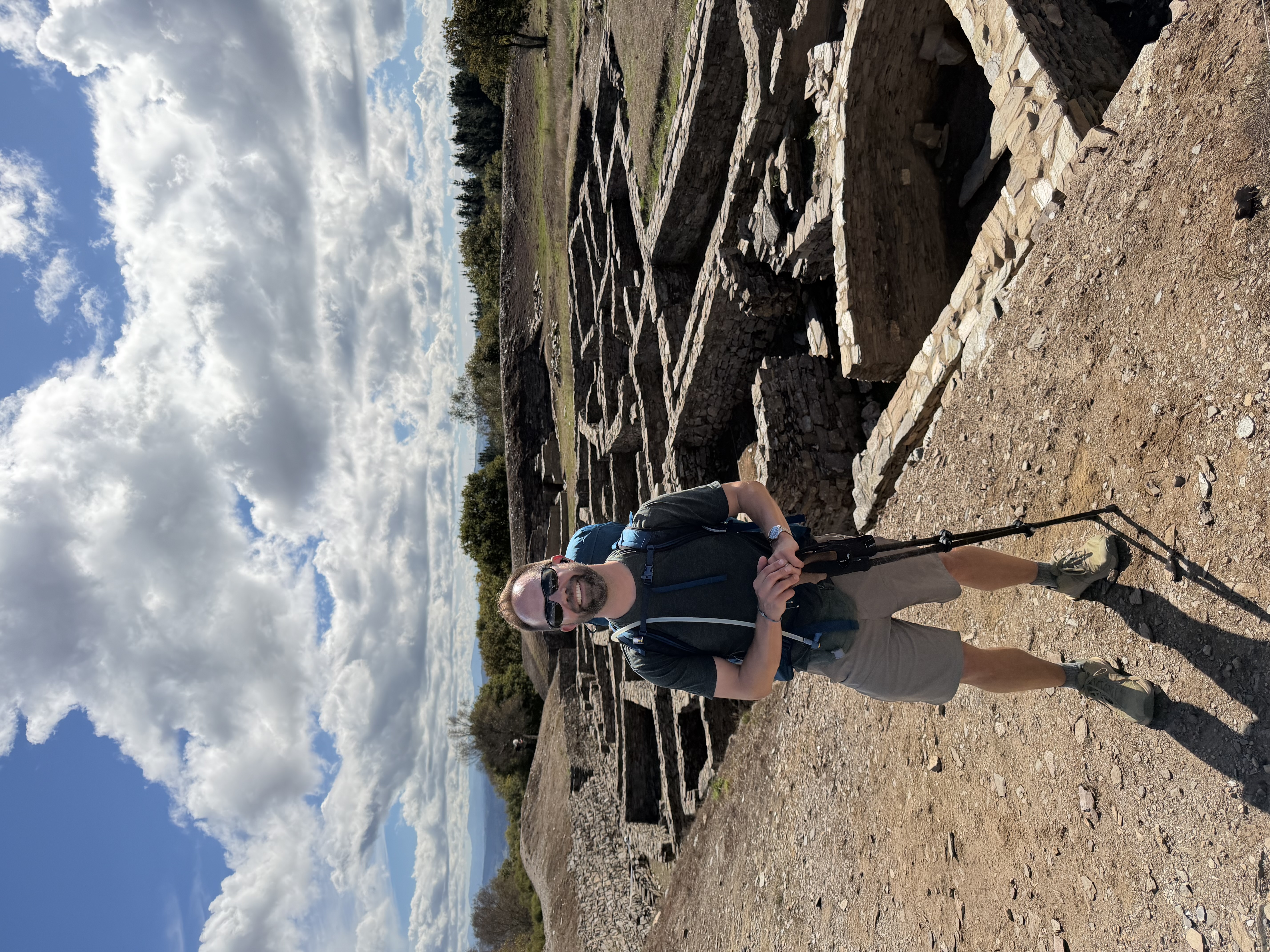
I continued on, pleased to discover an exit trail opposite the entrance that reconnected with the Camino, just as the couple who had recommended the ruins had suggested. As I rejoined the main trail, I spotted a woman whom I mistook for one of the Colombian pilgrims I’d met earlier.
“¡Hey! ¿Viste las ruinas?” I called out.
“No,” she replied.
“Oh, they’re really worth seeing! Just back there, ahí no más.”
She declined, indicating she just wanted to keep moving forward after that hill.
We were walking in the same direction, so we took the opportunity to chat.
She was from Peru and had also begun her Camino in Sarria. I told her I was from San Diego and started my walk in Saint Jean. Learning I live in Southern California, she was excited to tell me she often travels to Los Angeles for work in television production. She had walked part of the Camino previously and returned to finish what she’d started. Like the Colombian women earlier, she was impressed with my starting point.
Eventually, noticing my pace, she encouraged me to continue ahead, not wanting to slow me down. Before we parted, she reached into her belongings and offered me a small llama keychain, a token of our brief connection.
Another Sarria pilgrim. Another gift.
I thanked her. We exchanged a “buen camino,” and I continued on, llama in my pocket.
I assumed the rest of the day would follow a similar pattern – chatting with Sarria pilgrims in exchange for a small memento. But before long I ran into Stef, who I learned had taken a few breaks along his way that day.
It was nice to have some one-on-one time. We caught up on each other’s days. I told him about the ancient ruins and my encounters with the pilgrims from Colombia and Peru. We also shared our experiences of the Camino since Sarria. We agreed that the culture changed after Sarria, but the experience continued to be positive. I mentioned an exchange in one of the Camino WhatsApp groups earlier in the day. Someone asked whether the trail was crowded after Sarria, the question carrying a familiar sense of dread.
“Give the Sarria pilgrims a chance,” I replied. “They want to connect just like the rest of us.” The person who asked reacted to my response with a heart reaction.
As we continued walking, we emerged from the woods into a flatter, more open area when we spotted two familiar-looking pilgrims in the distance.
“Is that Lizzie and Hadrien?” I asked.
“That’s definitely Lizzie,” Stef replied. “I can tell by the walk.”
As we approached, the two crouched down and began examining something on the ground.
“What are they looking at?”
Knowing Lizzie’s background studying macroinvertebrates, I assumed she’d spotted a spider or some interesting insect.
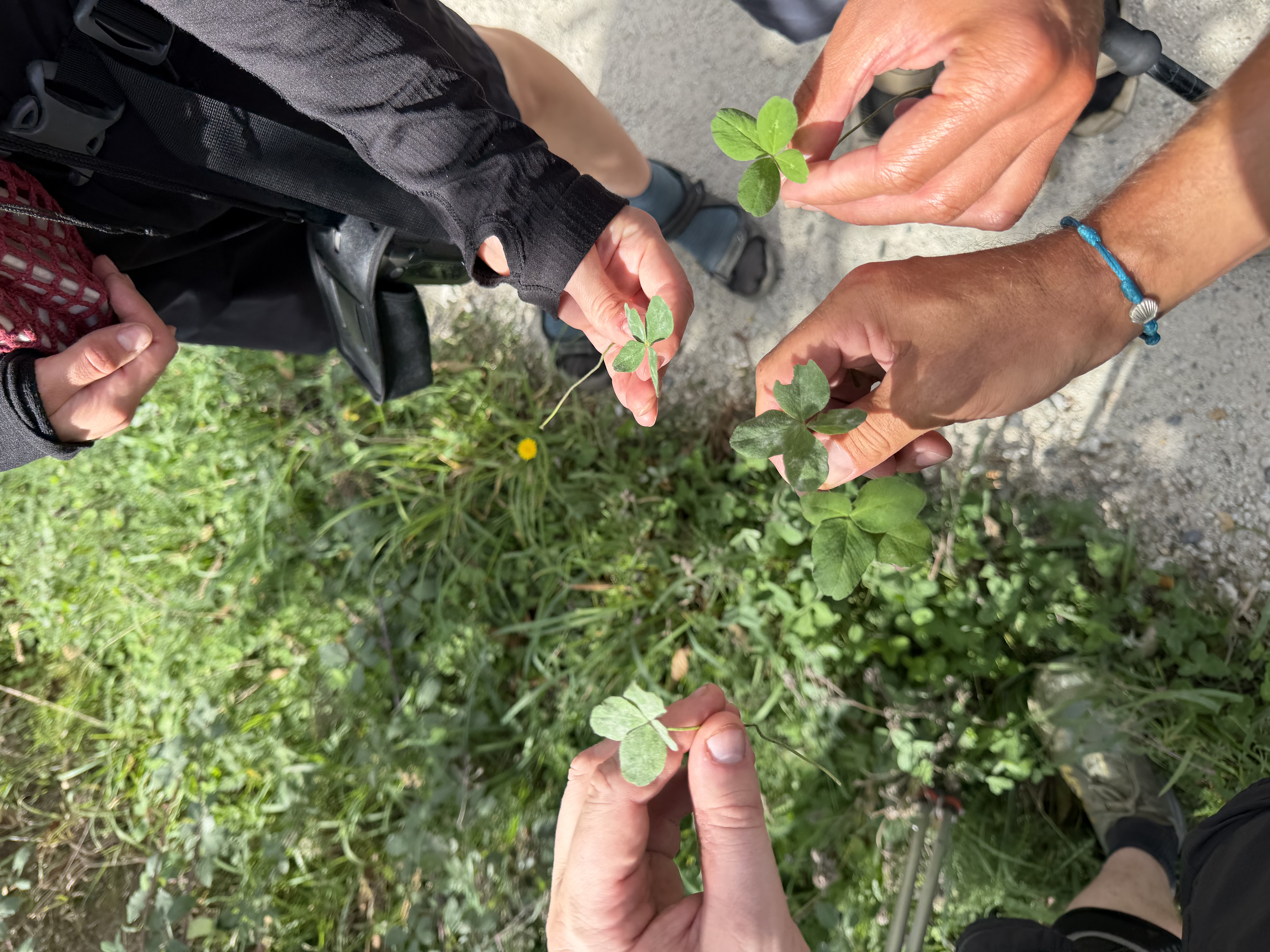
But as we drew closer, I saw that Hadrien had picked a small plant from the ground and handed it to Lizzie.
A four-leaf clover, just as we reunited after a day of walking separately.
I glanced down at the spot where they’d found it and almost immediately noticed another.
“Look! Here’s one more!”
The others began searching, too.
Another.
Then another.
And another.
We’d stumbled upon what seemed to be an entire grove of four-leaf clovers.
And just then, Ulrika appeared, accompanied by Dominic, a married pilgrim from Ghent, Belgium, who was walking the Camino alone to commemorate his 50th birthday. Ulrika had mentioned him several times over the preceding days, and the two, who were a bit ahead of Hadrien and Lizzie, circled back to investigate what was keeping their friends.
“What are you guys doing?” they asked.
“Finding four-leaf clovers!” There were enough to go around.
The time was 3 pm and attention turned to where we’d be staying that night. Dominic, Ulrika, and Stef already had plans for Casa Domingo. Lizzie decided to call to reserve spots for herself and Hadrien. She asked me if I wanted one too. Giving her a thumbs up, it was decided - we’d all be staying at the same albergue that night: myself, Lizzie, Hadrien, Ulrika, Stef, and Dominic, who would turn out to be the latest and final addition to my second Camino family.
Our happy group walked together for another couple of hours or so until we arrived at Casa Domingo.
We claimed our assigned beds, showered, and found places to relax. In my case, that meant a picnic table outside, where I settled in with my journal.
After finishing my entry, I noticed another pilgrim sitting alone nearby and introduced myself. His name was Fabian, and he was from Germany. We enjoyed a pleasant conversation, and later he joined us for dinner, bringing another voice to our increasingly lively table.
Dinner eventually gave way to singing.
This time, Hadrien finally got to finish La Corrida, the haunting French ballad about a bull facing his death in the ring. Unlike his interrupted performance a few nights earlier, this time he had an appreciative audience.
That’s when we learned Ulrika is also a singer. She introduced us to Stad i ljus (City in Light), a beloved Swedish song that she explained was traditionally sung at the end of an evening back home.
As our evening together drew to a close, Ulrika began to sing.
A note from you
Did something here resonate?
I’d love to hear from you.