The Journey Before the Journey
It’s 6:26 a.m., and I’m sitting in my guest room in Saint-Jean-Pied-de-Port with a cup of coffee.
I began stirring when it was still dark. I couldn’t wait to get out of bed. It’s only day three, and there’s already so much on my mind. I decided I’d journal.
Maybe this is an opportunity to practice something I’ve been thinking about at home: getting up early and doing some writing first thing in the morning, before the day really starts. Luckily, there was coffee in the kitchen downstairs. A nice couple was already awake and having breakfast, and they showed me how to use the machine. They were up before sunrise because they’re beginning their Camino today.
I grabbed my coffee and made my way back upstairs to capture some moments while the memories are still fresh in my head.
I arrived in Madrid around 2 p.m. on Saturday. The flight was lovely, and customs was a breeze. I made my way through the terminal. Despite the obnoxiously large advertising banner tempting me to pull out my phone and open an app, I resisted the temptation to call an Uber to take me into the City center and instead ventured into the Metro, where a nice woman helped me use the machines to purchase a subway ticket and pointed me in the right direction.
After around 40 minutes, I emerged near Plaza de Santa Bárbara to sunshine, cafés, trees and a little outdoor market, with vendors selling arts and crafts, clothes, trinkets and, of course, I also saw trash and recycling containers. Obviously, I documented the latter. If you know me and what I do, this is no surprise. Taking photos and videos of trash and recycling receptacles from around the world is a running gag among me and my coworkers.
From there I made my way on foot into Chueca, where I would spend my one night in Madrid.
When I checked into my hotel, I mentioned to the woman at the front desk that I was only in Madrid for one night because I was on my way north to walk the Camino. I also explained that I was hoping to purchase some trekking poles while in Madrid because I couldn’t carry them on my flight.
She pulled out a map, pointed me toward Decathlon, and also marked a few things I might want to see along the way.
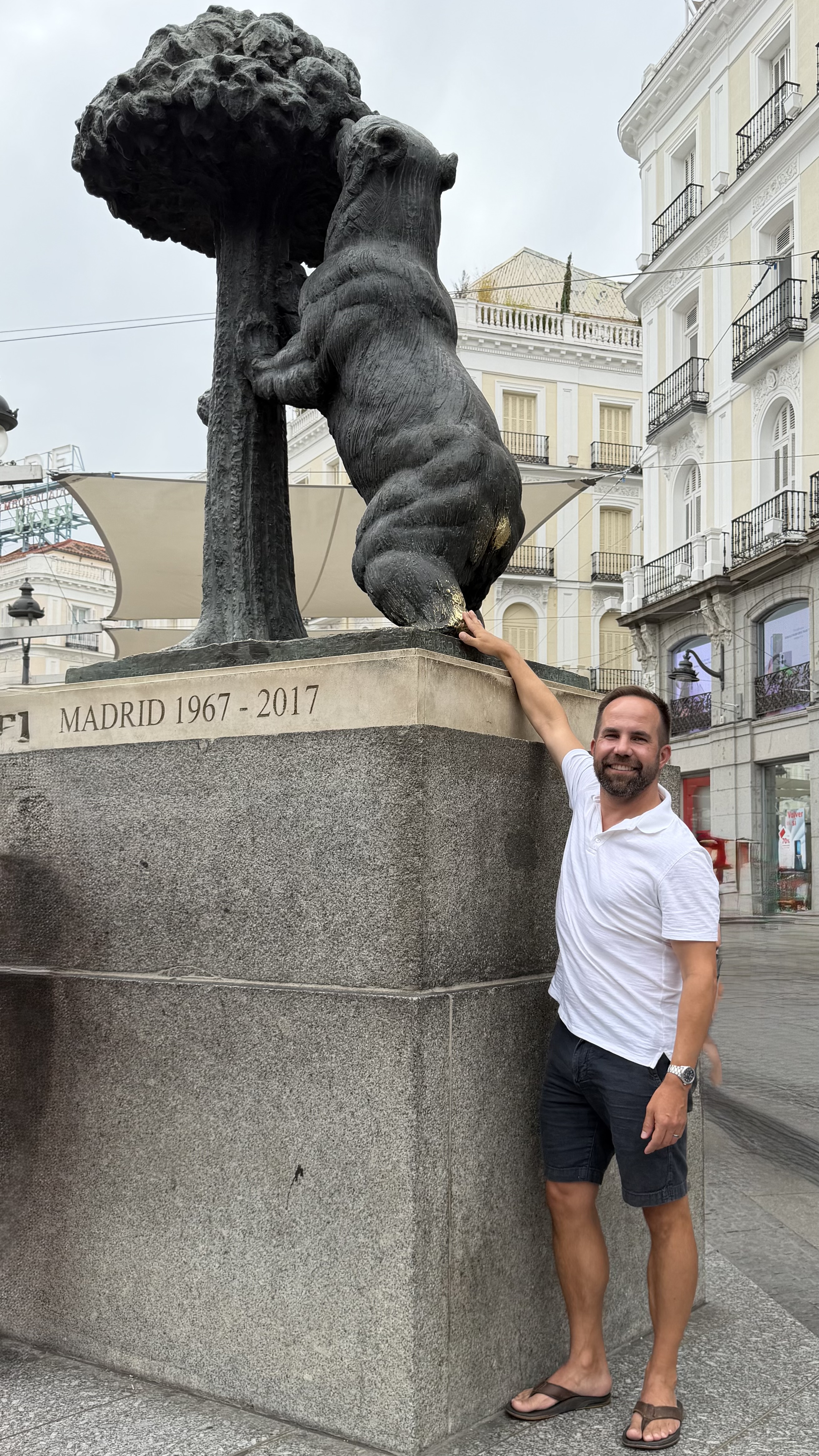
The Bear and the Strawberry Tree statue is the one that caught my attention. El Oso y el Madroño is located in Puerta del Sol, a short walk from Decathlon.
The bronze sculpture itself is relatively new, created by Antonio Navarro Santafé and installed in 1967. But the symbolism is much older. The bear appeared as a symbol of Madrid as far back as the Middle Ages, with the bear-and-tree emblem developing centuries before the statue we see today.
Apparently touching the bear brings good luck.
Naturally, I did.
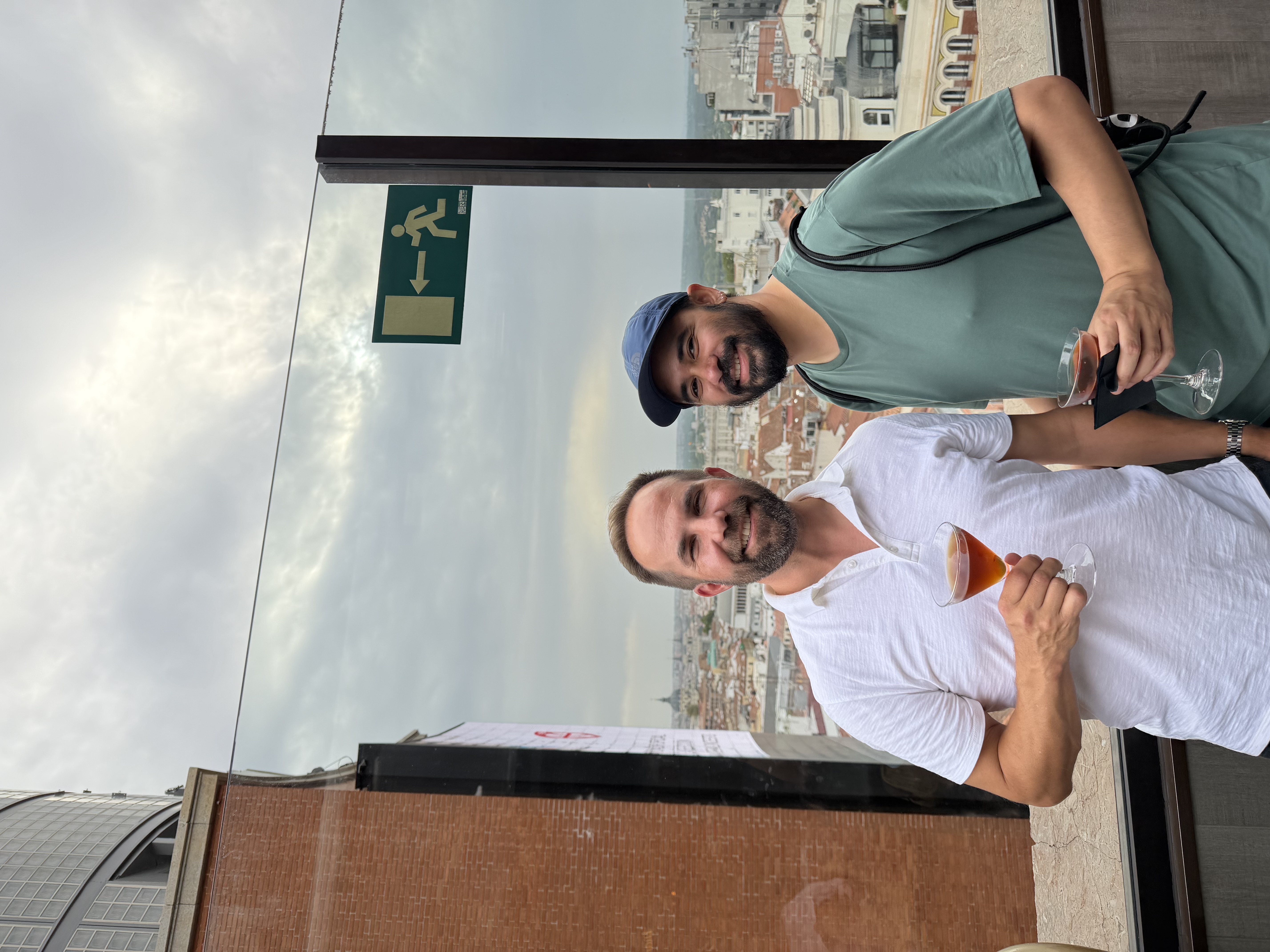
I had posted on social media that I was going to be in Madrid for one night. A friend from my days singing with the San Francisco Gay Men’s Chorus saw it and reached out. He has been in Madrid for the past couple weeks and will soon be a medical student here.
So instead of spending my one evening in Madrid alone, I got to spend some of it with a friend. We had drinks at a rooftop bar near Plaza del Callao and wandered around Chueca for a while.
As tempting as closing down the bars might have been, jet lag was catching up with me, so it was a short night. After the travel, I was exhausted, and by about 9:30 I was asleep.
Early Sunday morning, I went looking for coffee and spent some time journaling. Funnily enough, I passed some young people in the plaza, stumbling with their arms around each other and singing together happily, and incoherently. I suspect they had done what I avoided.
I’m glad they had a good night out!
I made it back to my hotel for a bit longer and then began a meandering walk to the station to catch my train, scheduled to depart around 1 p.m.
It was time to make my way toward Saint-Jean.
I decided to walk to the train station, taking the long way through Parque del Retiro.
There were trees everywhere, paths crisscrossing through the park, people walking, jogging and doing yoga, a large pond with paddle boats, water features, ducks, street musicians and lots of statues.
One that caught my attention was El Ángel Caído. You don’t normally see depictions of fallen angels in public works of art. I was struck by the portrayal of anguish and regret in the face and contorted body.
I looked it up and learned the sculpture dates back to 1877, by Ricardo Bellver, inspired by John Milton’s Paradise Lost, and depicts Lucifer at the moment of his fall.
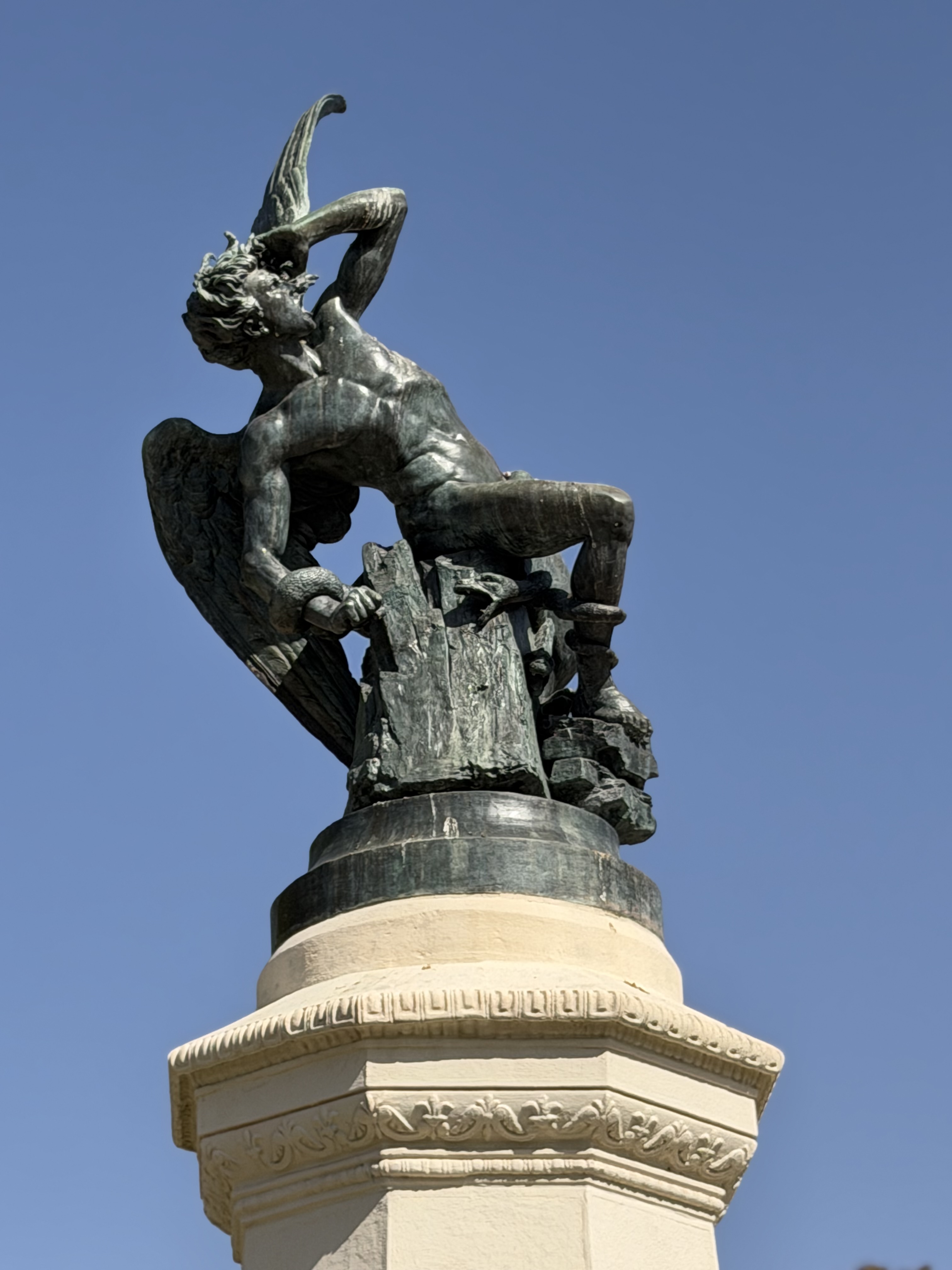
According to Madrid legend, the statue sits at exactly 666 meters above sea level. I checked the elevation via a GPS app and it appears to be pretty close, within a few meters. Not sure if this was intentional, a coincidence, or something else. Very curious.
In any event, I kept walking.
Eventually I reached the train station and began the long ride north.
I took an embarrassing number of video clips through the train window, capturing golden fields, little towns, encinas (holm oaks), train stations, and mountains beginning to appear in the distance.
With no direct route to Saint-Jean, or even Pamplona, I looked ahead to a 2.5-hour stopover in Zaragoza.
What could easily have been a purely utilitarian break, get off one train, sit in the station for two hours, get on another train, actually turned out to be one of the most meaningful moments of my journey so far.
I decided two hours gave me enough time to aprovechar, to take advantage of the opportunity, and see at least a little of the city.
I couldn’t have planned what happened next.
I climbed into a taxi at random and told the driver, Javier, that I only had about two hours. I explained that I was traveling to Pamplona and then on to Saint-Jean-Pied-de-Port because I was about to walk the Camino de Santiago. I asked about seeing the main plaza and church, but told him I didn’t know much about them.
As we drove, Javier began telling me about Zaragoza and the Virgen del Pilar.
According to Christian tradition, the Virgin Mary came to the Apostle James here in Zaragoza around the year 40, while James was preaching in Roman Hispania. She appeared standing upon a pillar and encouraged him in his mission.
That pillar is still venerated today inside the Basílica de Nuestra Señora del Pilar.
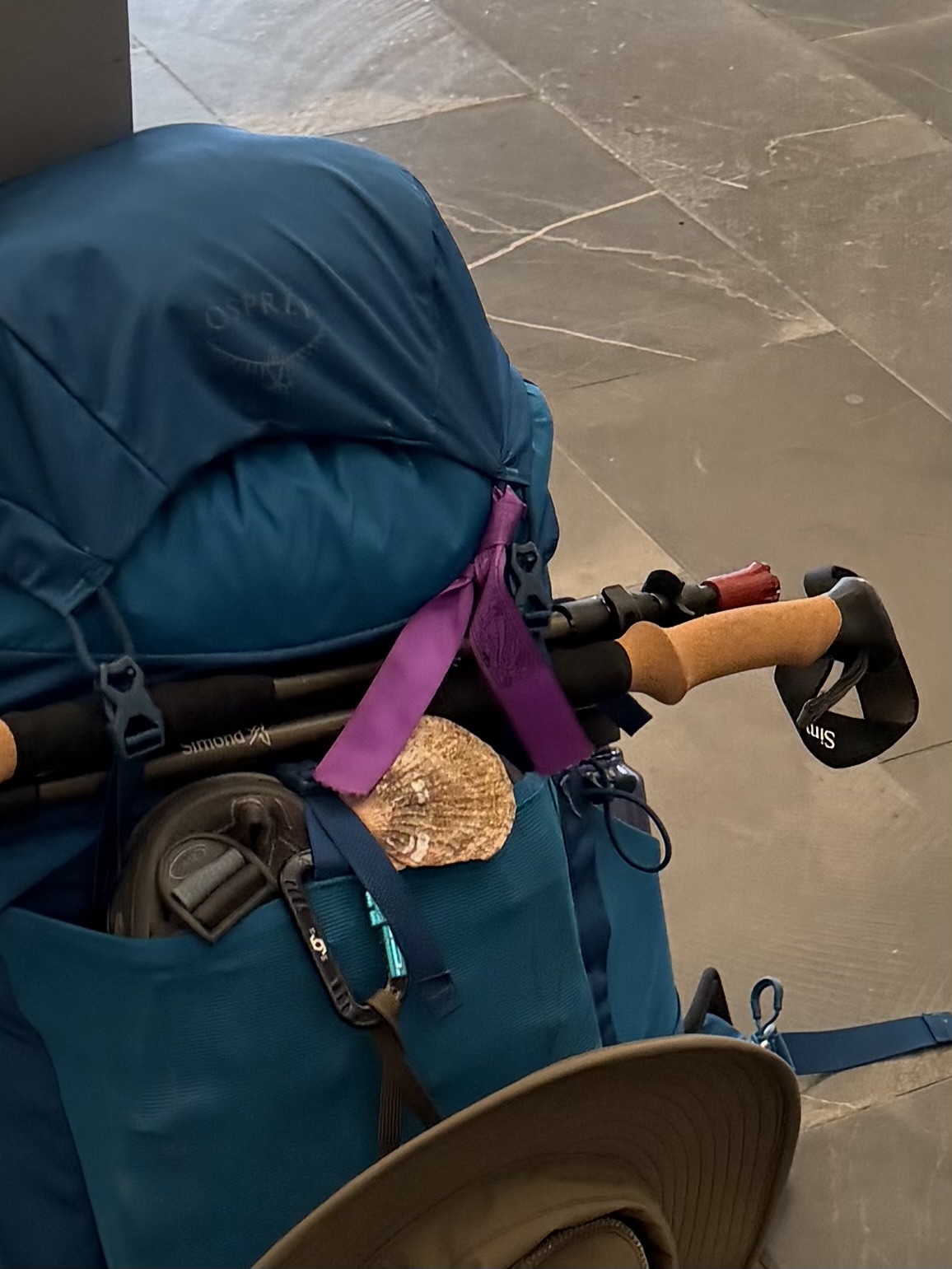
Javier also told me about the medida, a ribbon approximately 36.5 centimeters long, traditionally associated with the Virgen del Pilar.
As we talked, I saw him become pensive, consider what to do next, and then pull a ribbon from his rearview mirror and hand it to me.
He went on to explain that I’d likely encounter vendors selling these ribbons in shops, but that they weren’t meant to be souvenirs I should buy for myself. Rather, the medida, he told me, was something to be given.
He gave his to me as a blessing for my Camino, to protect me and keep me safe.
And he told me that someday, if it felt right, I could give it to someone else.
It goes without saying that had I remained in the train station, or even chosen another taxi, none of this would have happened.
After Javier dropped me off, I walked toward the basilica.
And then I noticed something in the pavement. A scallop shell. The symbol of the Camino.
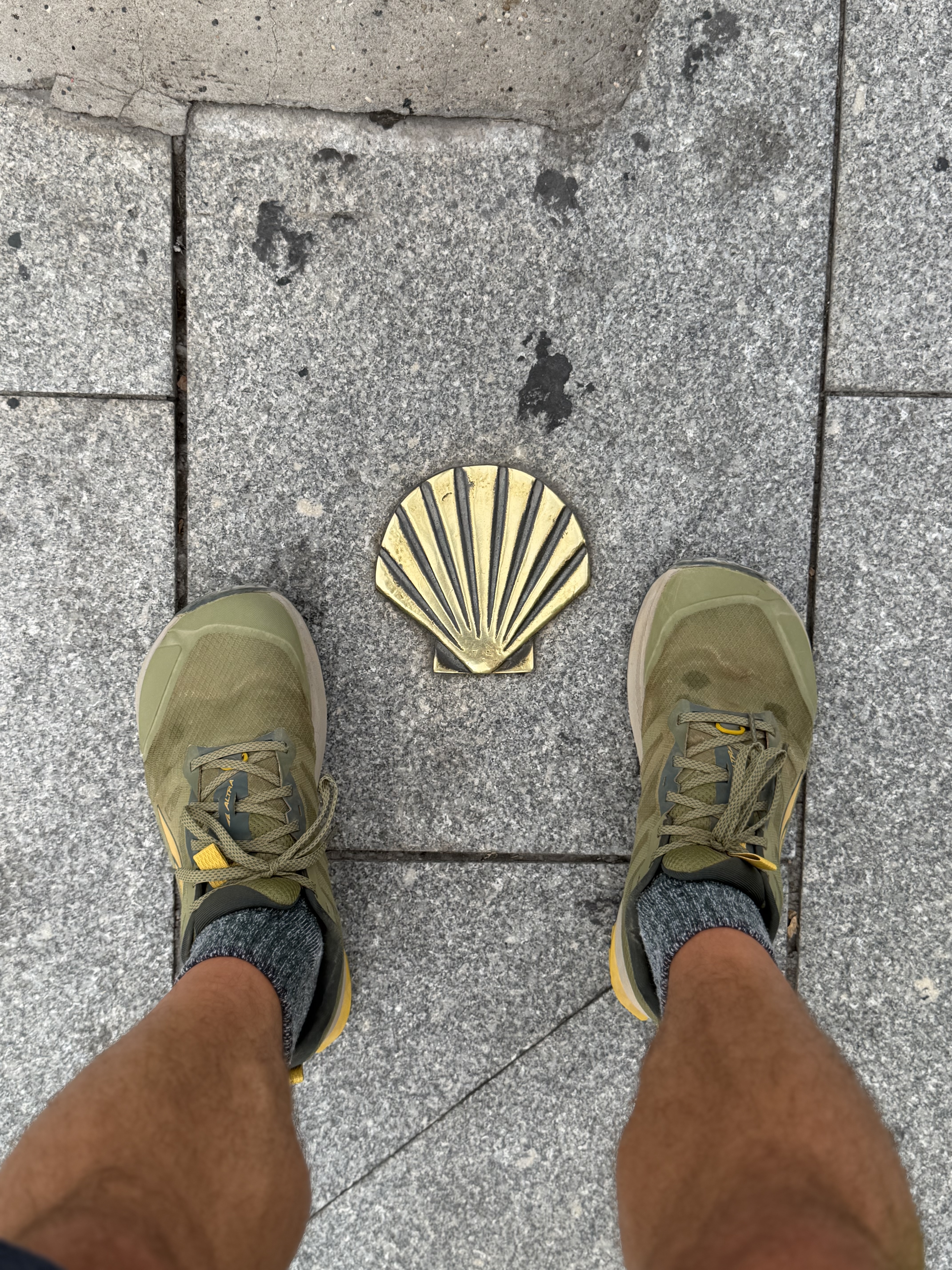
I hadn’t known it beforehand, but I later learned that Zaragoza itself sits along one of the pilgrimage routes toward Santiago, the Camino del Ebro. Nearby, the Puente de Santiago crosses the Ebro River, and Camino routes through this part of Spain eventually connect pilgrims with the better-known routes farther west.
I walked the grand plaza and made my way into the Basílica del Pilar. After a contemplative lap around the church, I was drawn to the Santa Capilla, or Holy Chapel, where the Pilar is venerated.
I knelt before the Pilar and prayed.
Maybe it was simply happenstance, but what was supposed to be a schedule gap between two trains had somehow become a meaningful part of my pilgrimage.
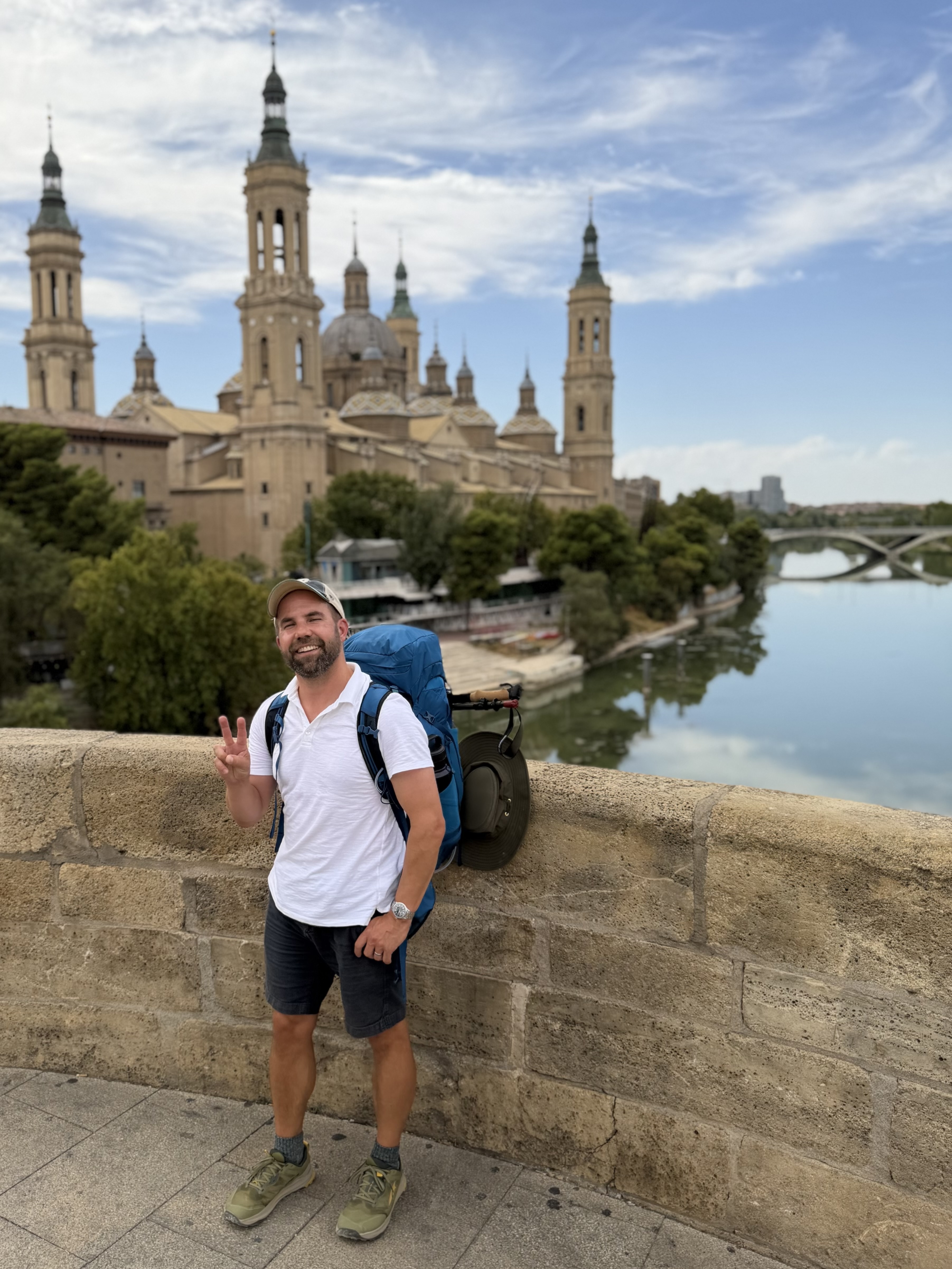
From Zaragoza, I continued north to Pamplona.
A taxi was waiting there to take me the rest of the way to Saint-Jean. As we drove toward the Pyrenees, the driver pointed out places along the way, including the area associated with the Battle of Roncesvalles from the time of Charlemagne.
The breathtakingly beautiful views nearly left me misty-eyed.
Eventually we climbed high into the mountains and crossed into France.
As the road began descending toward Saint-Jean, my driver laughed and pointed out that, for now, we were going down, down, down.
“But for you tomorrow…”
Up, up, up.
We both laughed.
And now I’m here.
Coffee beside me. Saint-Jean outside my window. Other pilgrims already beginning to move around downstairs.
I open my window to catch a glimpse.
That’ll be me tomorrow.
Today I’ll explore the town, get my pilgrim’s passport, and prepare.
Tomorrow I start walking.
A note from you
Did something here resonate?
I’d love to hear from you.