Stage 22
The Iron Cross
The clouds hung low. There would be no colorful sunrise this damp early morning.
A line of interspersed pilgrims solemnly ascended the dark trail, up the hill past Foncebadón, the small mountain town where I had slept the night before.
Our destination: the literal geographic peak of the Camino Frances. At about 4,900 feet above sea level, history documents this high point as having served as a landmark for pilgrims for a thousand years, if not longer, guiding travelers on their physical east-west journeys.
Today the spot, home to the Cruz de Ferro, the Iron Cross, also supports pilgrims on the direction of their spiritual journeys. I shared a bit on this custom in an earlier article “What We Carry, What We Leave Behind, What We Bring Home.”
Sources cite the tradition of pilgrims leaving stones here on the Camino de Santiago for nearly 200 years, though legend tells a longer story, suggesting travelers may have been piling or throwing stones at significant points along roads such as this one since before the time of Christ.
I arrived that morning and, for a short while, took in the space from a bench facing the cross. I watched pilgrims come and go. Some joyous. Most contemplative. Some crying.
When I was ready, I ascended, standing on a mound of countless stones, each a dedication, burden, hope or dream. I closely held my own two stones, symbols of my personal intentions, taking far more time than I anticipated to reflect upon them before letting them go.
One I brought from home, a piece of pyrite, also known as fool’s gold, named for its visual resemblance to a precious metal while holding no actual economic value. The other, a stone I picked up on the walk up the trail leading to the Cruz de Atapuerca about a week and a half ago.
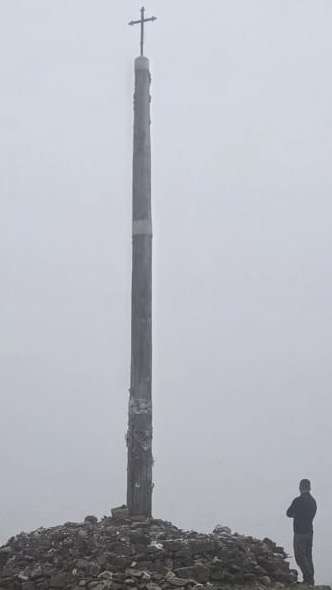
While my intentions are personal and I won’t describe them here, I will say I placed them as signs of intent, hopeful aspirations, rather than achievements.
Once I was ready to continue, I looked around for any familiar faces and found Osama, Jacopo, and Beatrice, and together we agreed that we were ready to move on.
The weather was turning, and it was clear it would soon rain. Not more than 30 minutes down the trail, we found a rustic café with a cozy wood-burning fire inside and a bar serving hot chocolate. All agreed we would stop here.
All the tables were occupied, and some considered continuing on the trail, until we noticed the Israeli family we have met at dinner last night waving at us from the table by the fireplace. They would soon be moving on and invited us to sit with them until they finished.
Discussing our respective areas of work, I learned the mother is a landscape architect who helped to design a park out of a former landfill. I was excited to tell her about our own landfill in San Diego soon reaching capacity in the coming years.
There’s never a shortage of people who will talk trash.
The family moved on, and my small group of pilgrims lingered, savoring the warmth of our mugs of hot chocolate and the hot, orange crackling fire to our side.
Eventually it was time to go. It gave Osama and me a good chance to talk at greater length since our first meeting in the plaza in Leon.
We naturally paired off during our conversation, going deep into why we chose to walk the Camino.
All the while, it was raining, and we, or at least I, struggled to navigate a terrain of descending, uneven, cracked slate.
This was probably the most difficult stretch of the Camino for me so far, both physically and mentally.
The continuous downhill walk on wet, uneven terrain was putting my tibialis anterior muscles to work, and they weren’t happy.
Mentally, the challenge was attributable not only to the heavy topics we chose to discuss, but also because we asked tough follow up questions. We each approached the conversation with curiosity and non-judgment, and answered honestly, leading to deeper questions and further challenges.
Some people describe the Camino as a liminal space, a place between who you were and who you will become. No one here knows who you were before you arrived, and you don’t yet know exactly who you will be when you leave. With no pre-held images to maintain, I’ve found my fellow pilgrims to be remarkably transparent from the beginning and even more so as honesty and openness beget more of the same.
After several hours of walking and discussion, Osama and I parted ways in Ponferrada, heading towards our respective albergues. Later I thanked him for spending the day walking with me and for the deeply meaningful conversation
I had plenty to unpack and process that day, as I closed the mental phase of the Camino, ready to embark upon the spiritual.
A note from you
Did something here resonate?
I’d love to hear from you.